How do We Engage Gen Z Relationally?
Gen Z lives and works differently from previous generations. They’re highly relational people both on and offline; the best ways to engage Gen Z relationally are to BE relational: Listen more, talk less, and ask more questions that really help them open up and share. Authentic hospitality is also key: invitations to participate IRL (in real life) are meaningful and intentional paths forward. Finally, Gen Z is crafting lives of meaning and purpose. Invite them or join them in acts of care and meaning.
In this article, we’ll cover
What makes Gen Z so unique
Three meaningful ways to engage: Listen, Invite, co-participate.
Short specific examples and prompts to listen well to Gen Z
What makes Gen Z so unique?
Gen Z has some global characteristics that make engaging them with the gospel a little different than other communities or previous generations. They grew up among social and economic disruption, they’re the first generation to grow up in a digital-first lifestyle, and they struggle more with anxiety and loneliness than previous generations. All of these characteristics make them a group that
They grew up in a time of economic and social turmoil.
In the background of their childhood, Gen Z lived through 9/11 and multiple financial crises, watched friends or family lose their houses in the 2008 real estate crash, and finally experienced the disruption of COVID. For the oldest Gen Zers, their lives have been marked by uncertainty, tragedy, and deep social and economic divisions. By the time the pandemic rolled around, they had seen their parents lose jobs, possibly more than once.
This uncertainty and instability have led Gen Z to reevaluate long-held conclusions about work and life. Less than 6% of Gen Z plans to pursue leadership at work, but they care deeply about work-life balance and about creating lives of meaning and purpose.
They’re the first digital-first generation.
What’s digital-first? It means that basic life is lived digitally: banking, health appointments, school-work, entertainment, college applications, shopping, etc all take place online. Gen Z is the first generation to live like this from childhood. Living a digital-first life takes its toll, and they also struggle in greater numbers with anxiety and loneliness than previous generations. And on the flip side, their digital-first life also made them very individualistic: the internet's personalization gave them a mindset that can be somewhat more confining than liberating.
Their experience with an uncertain economic life, combined with a digital-first life, means that Gen Z might not think in terms of ownership but rather of access to services, placing a high value on them. They love grocery and food delivery, they drive less than previous generations. The internet affords them nearly unfettered, frictionless access to life and world views, including theology. As a result, Gen Z likes a fast-paced life with instantaneous results, but they also feel exhausted by this breakneck pace.
They struggle with loneliness and anxiety more than previous generations.
Their breakneck pace of digital access, personalization, and a lifetime growing up against a backdrop of uncertainty eventually takes its toll. An emphasis on individualism in a digital-first life means that Gen Z reports more instances of anxiety and depression. Loneliness means they begin to seek out real-life relationships.
But the pressure of digital-first life has also driven them more towards religion, even as they are more unchurched than previous generations. They’re the group responsible for the 22% rise in Bible purchases. It seems that struggling with anxiety and loneliness has sparked a conversation about who God is for them and what he has to say about what’s happening in the world.
What are the best ways to engage with Gen Z?
Based on the unique characteristics of of Gen Z, their complex upbringing, their digital-first life, with its outcomes of increased church attendance, and increased mental health challenges, there are three strong practices we can adapt as we move toward Gen Z in love.
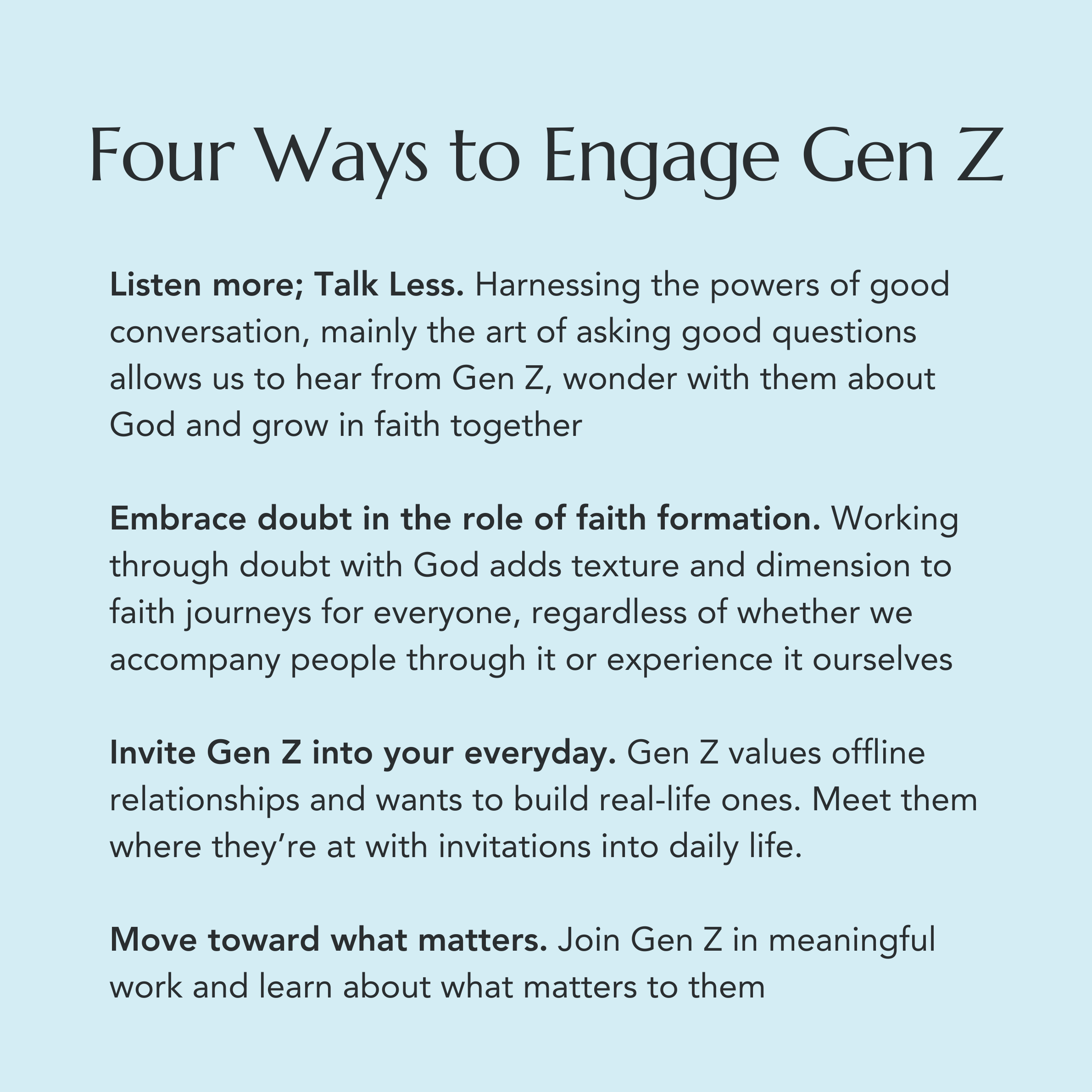
Listen more, talk less. Gen Z values egalitarian relationships and pursues faith. Harnessing the powers of good conversation, mainly the art of asking good questions allows us to hear from Gen Z, wonder with them about God and grow in faith together. A few of my favorite questions and prompts (that work in any relationship or situation!) are:
Tell me more about that.
What was that like in the moment?
What else do you want to know about this/God/topic?Embrace doubt in the role of faith formation. Most of Gen Z is unchurched, and doubt is part of their journey toward a life with God. The more we can help them wrestle with and through bouts of doubts, the more we gain credibility as trustworthy faith-building partners. I’ll write more about this later. But doubt adds texture and dimension to faith journeys for everyone, regardless of whether we accompany people through it or experience it ourselves.
Invite Gen Z into your everyday. Highly digital Gen Z values offline relationships. Bring them along with you into the everyday through dinner, game night, Sunday afternoon football. Involve them in small groups or church social events, and you’ll both build strong relationships and grow in faith.
Lastly, extend meaning and purpose to Gen Z. Join them in meaningful work, and learn about what matters to them. Along the way, listen more and talk less. You’ll be surprised at what you gain when you’re on Gen Z’s turf.
Read More about Engaging Gen Z
Gen Z is global, collaborative, curious, and relational.
GenZ is the least churched generation to exist.
They are also buying the most Bibles, signaling their openness and curiosity about faith.
We need to learn how to motivate young Gen Z believers to participate in mission.
Conclusion
What we learned about Gen Z:
They grew up in a time of economic and social turmoil.
They’re the first digital-first generation.
They struggle with loneliness and anxiety more than previous generations.
We can engage them by
Listening more, talking less.
Embracing doubt in the role of faith formation.
Inviting Gen Z into your everyday.
Extending meaning and purpose to Gen Z
About the Author:
Charity Starchenko has a ThM in Missiology from Edinburgh Theological Seminary. Her research and writing revolve around the welcome and enfoldment of new and returning believers into the life of the local church. She uses her many years of experience in marketing and branding to help churches build sustainable digital preferences that lead to meaningful relational discipleship for all who come to church.